
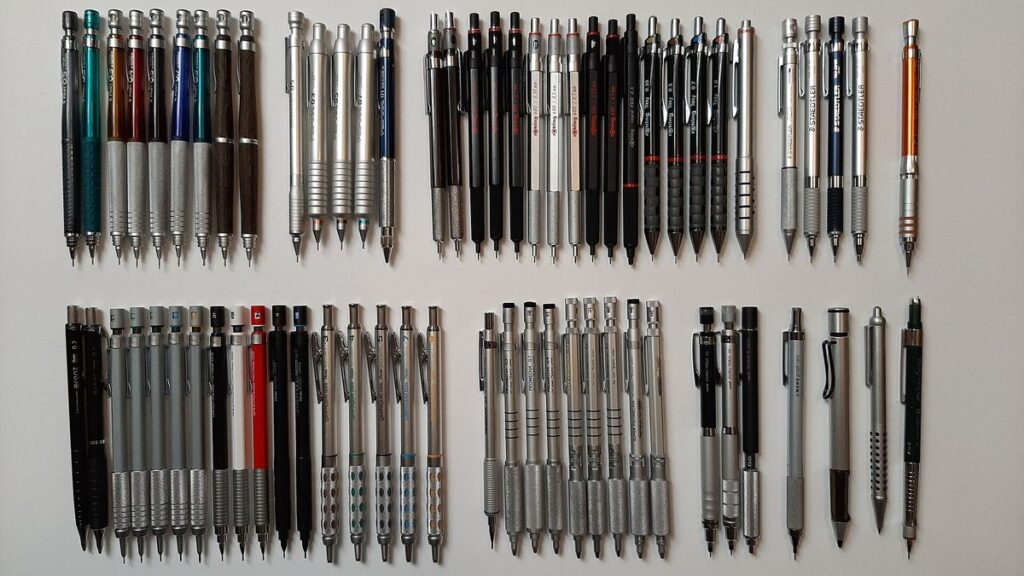
Mechanical pencils look simple, but anyone who has bought one on impulse knows the frustration: the lead snaps every few words, the lines look too faint on the page, or the tip smudges across your carefully planned spread. Most of these problems have nothing to do with the pencil itself. They come from choosing a lead size and hardness that do not match the way you write or draw.
In this guide you will learn what the numbers on lead packs mean, how lead size affects your lines, how the hardness scale works, and which combinations tend to suit journaling, planning, sketching and everyday notes. You will also find a few simple care habits that keep a mechanical pencil working well for years.
Why choose a mechanical pencil at all
Before getting into lead, it helps to know why so many journalers and planners keep a mechanical pencil in their pencil case:
- Consistent line width. A wooden pencil gets duller as you write, while a mechanical pencil keeps the same line from the first word to the last.
- No sharpener needed. A click or two brings out fresh lead, which is handy when you are working at a desk, on a train or in a café.
- Clean drafts. Pencil is ideal for sketching layouts, guidelines for hand lettering and rough notes that you will ink later.
- Erasable planning. Plans change. Writing appointments or habit tracker entries in pencil lets you adjust without covering pages in correction tape.
The two choices that shape almost everything about the writing experience are the diameter of the lead and its grade.
Understanding lead size
Lead size refers to the diameter of the lead, measured in millimeters. The most common sizes are 0.3, 0.5, 0.7 and 0.9 mm, and you will also find thicker options of around 2 mm used in lead holders. A pencil is designed for one specific size, so always check the size printed on the barrel or clip before buying refills.
0.3 mm: fine detail
This is the thinnest common size. It produces crisp, delicate lines that work well for tiny handwriting, detailed technical drawings and small boxes in dense weekly layouts. The downside is fragility: thin lead breaks more easily, especially if you press hard or hold the pencil at a steep angle. It suits people with a light touch.
0.5 mm: the all-rounder
The 0.5 mm size is the most widely available and a safe starting point for most people. It is fine enough for neat notes in a standard ruled notebook and strong enough to survive everyday use. If you are buying your first good mechanical pencil, this is usually the size to choose.
0.7 mm: smooth and sturdy
A slightly thicker lead feels smoother on paper and breaks less often. Many people who find 0.5 mm too scratchy or fragile are happier with 0.7 mm. It works well for larger handwriting, quick journaling and sketching rough shapes.
0.9 mm and thicker: bold and expressive
Thick leads produce bold lines and are very resistant to breaking. They are popular for sketching, shading, writing on textured paper and for anyone who naturally presses hard. In a planner with small boxes, however, they can look heavy and crowded.
Understanding lead hardness
The second number you will see on a lead pack is the grade, such as HB, 2B or H. It describes how hard or soft the lead is, which in turn affects how dark the line looks and how easily it smudges.
The scale runs roughly like this:
- H grades (H, 2H, 3H and higher): harder lead that leaves a lighter, crisper line. It smudges less and the tip stays sharp longer, but it can feel scratchy and the line may look faint.
- HB and F: the middle of the scale. HB is the standard grade for writing and offers a balance of darkness and durability. F sits just slightly on the harder side of HB.
- B grades (B, 2B, 3B and higher): softer lead that leaves a darker, richer line. It glides more easily and is pleasant for sketching, but it wears down faster and smudges more.
Grades are not perfectly consistent between manufacturers. A 2B from one maker can look noticeably darker or lighter than a 2B from another. When you find a lead you like, note the brand and grade so you can buy it again.
How size and hardness interact
Thin leads in very soft grades tend to break easily, because soft lead is weaker. That is why 0.3 mm leads are often most comfortable in HB or harder, while thicker leads handle soft grades well. If your 0.5 mm lead keeps snapping, moving one step harder (for example, from 2B to B or HB) can help as much as switching size.
Matching lead to the way you use paper
The best combination depends on your paper, your handwriting and what you are making. These pairings are a good place to start:
- Daily notes and to-do lists: 0.5 mm in HB. Clear, readable and durable.
- Small handwriting or dense weekly spreads: 0.3 mm in HB or F, so letters stay crisp inside tight boxes.
- Pencil guidelines for hand lettering or inking: 0.5 mm in H or 2H. The lines are light enough to erase cleanly after you go over them with a pen.
- Sketching and doodling in a journal: 0.7 mm or 0.9 mm in B or 2B for smoother, darker lines and easy shading.
- Writing on thin paper: a harder grade helps, because soft lead can transfer to the opposite page when the notebook is closed.
- Textured or heavier paper: softer and thicker leads glide better and fill the tooth of the paper more evenly.
If you journal on smooth, thin paper, test your lead on the last page first. Write a few lines, close the notebook, press on the cover, and then check for transfer to the facing page.
Choosing the pencil body
Once you know what lead you want, look at the pencil itself. A few features make a real difference in daily use:
- Grip. Rubber or textured grips help if you write for long periods. Metal knurled grips feel secure but can be tiring for some hands.
- Weight and balance. Lighter pencils are easy to carry in a planner loop. Heavier, front-weighted bodies feel steadier for drawing.
- Retractable tip. A retracting sleeve protects pockets and pencil cases from the sharp metal tip.
- Eraser. Most pencils have a small eraser under the cap. It is handy for quick corrections, but a separate eraser works better for larger areas.
- Lead advancement. Some pencils advance lead with a click at the top, others with a side button or a shake. Choose the mechanism you find most comfortable.
Simple habits that prevent breakage and smudging
A few small habits make a mechanical pencil far more pleasant to use:
- Extend only a little lead. About 1 mm is plenty for writing. Long tips snap easily.
- Lower your angle. Holding the pencil less upright reduces pressure on the tip.
- Ease off the pressure. If you see grooves on the back of the page, you are pressing harder than needed. A softer grade can give the same darkness with less effort.
- Rotate as you write. Turning the pencil slightly every so often keeps the tip from wearing into a flat, wide edge.
- Protect finished pages. Slip a sheet of scrap paper under your hand while writing, and consider a harder lead in planners that you close and carry every day.
- Store refills safely. Keep spare lead in its case and do not overfill the pencil’s reservoir, which can cause jams.
Clearing a jam
If lead stops advancing, remove the eraser and any leftover lead pieces, then push the clutch at the tip open by holding the button down. Many pencils come with a thin cleaning pin attached to the eraser, which can be used to gently push a broken piece of lead out through the tip. Avoid forcing anything, as the small parts inside are delicate.
Summary
Choosing a mechanical pencil becomes much easier once you understand the two main variables. To recap:
- Lead size controls line width and strength: 0.3 mm for fine detail, 0.5 mm as the all-rounder, 0.7 mm for smoothness and 0.9 mm or thicker for bold, sturdy lines.
- Lead hardness controls darkness and smudging: H grades are lighter and cleaner, B grades are darker and softer, and HB sits in the middle.
- Thin leads pair best with medium or harder grades; thick leads handle soft grades well.
- Match the combination to your paper and your project, and test on a spare page first.
- Short lead extension, a lower angle and lighter pressure prevent most breakage.
Start with a 0.5 mm pencil and HB lead, notice what you like and dislike, and adjust one variable at a time. Within a few weeks you will know exactly which combination makes your journal and planner pages look their best.
Photo: Mechanical Pencils 2019, by J. C. Barros, license CC BY 2.0, via Wikimedia Commons. Cropped.