
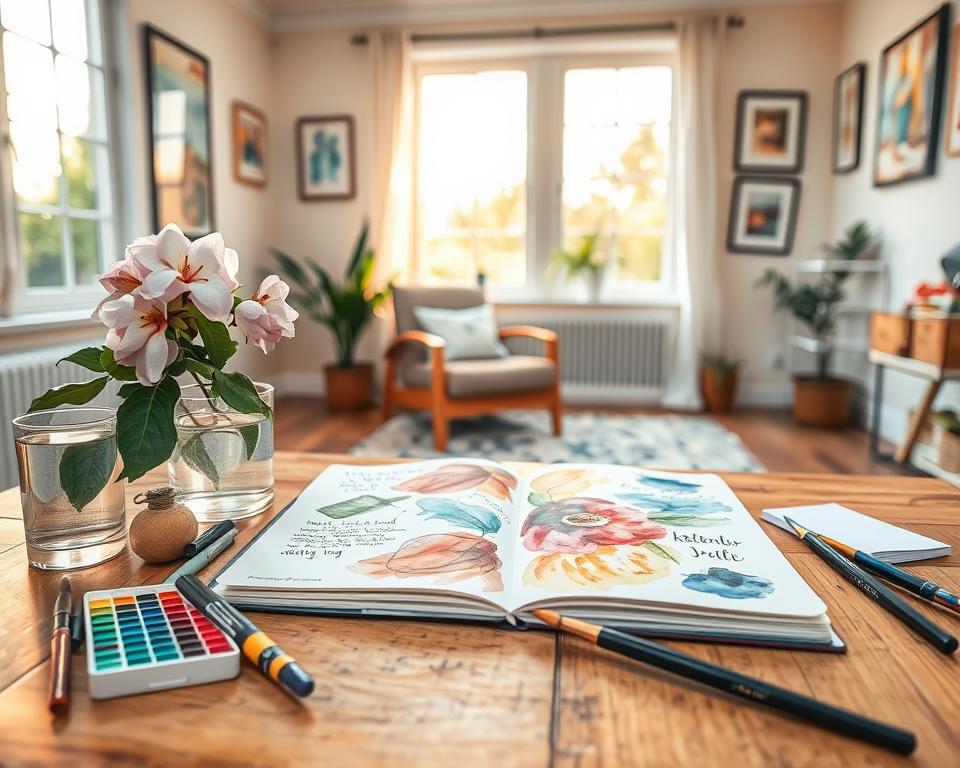
Did you know that adding art to your daily life can lower stress and increase creativity? Watercolor journaling is a special way to explore your creative side.
When you mix watercolors with journaling, you get a powerful tool for expressing yourself. This art lets you share feelings and thoughts with colors and textures. It’s perfect for those looking for a creative break.
By diving into watercolor journaling, you open up new ways to be creative and understand yourself better. This journey not only boosts your creativity but also offers a calming escape.
Key Takeaways
- Watercolor journaling reduces stress and boosts creativity.
- It serves as a unique means of self-expression.
- Combining art and journaling fosters a deeper understanding of oneself.
- This art form provides a therapeutic outlet.
- It unlocks new avenues of creative expression.
What is Watercolor Journaling?
Watercolor journaling is a mix of watercolor art and journaling. It lets me express my creativity in a special way.
My Journey into Watercolor
I started watercolor journaling to explore new artistic paths. The bright colors and flowing paint drew me in. Adding journaling to my watercolor made my art richer, letting me share stories and feelings.
Working with watercolors is both calming and thrilling. It teaches me to be patient and accept surprises, letting go of the need for perfection.
The Benefits of This Creative Outlet
Watercolor journaling is a healing escape from digital life. It connects me with my creative self and helps me share feelings that words can’t. The artistic techniques improve my skills and help me see the world differently.
This hobby has also been a journey of self-discovery. It lets me reflect on my life and emotions. Through art journaling, I’ve found a unique way to keep memories, making it a fulfilling hobby.
Essential Supplies for Watercolor Journaling
Starting your watercolor journaling journey means getting the right tools and materials. I found that the right supplies make a big difference in your experience.
Must-Have Watercolor Tools
You’ll need a few key tools to begin. First, watercolor paints are essential. I like pan paints for their ease and portability. A watercolor brush is also vital; start with a round brush size 6 or 8 for versatility.

Choosing the Right Paper
The paper you choose is very important. Cold press paper is best because it holds texture and water well. Make sure it’s labeled as “watercolor paper” or “mixed media paper.” Start with at least 140 lb (300 gsm) to avoid bleed-through.
Recommended Brands for Beginners
For beginners, knowing good brands is helpful. For paints, Winsor & Newton Cotman is a great choice. For paper, Canson and Arches are top picks. For brushes, Escoda and Da Vinci have good options.
A famous watercolor artist once said, “The right tools can make all the difference in your artistic journey.” I agree, as good supplies have improved my journaling.
“The right tools can make all the difference in your artistic journey.”
- Watercolor paints
- Watercolor brushes
- Water container
- Palette
- Watercolor paper
With these essential supplies, you’re ready to dive into watercolor journaling.
Techniques to Enhance My Skills
My watercolor journaling skills have grown a lot. I’ve tried many artistic techniques. These methods have made my art better and deepened my connection to it.
Basic Watercolor Techniques
Learning the basics of watercolor is key to making beautiful journal pages. I started with simple washes, wet-on-wet, and drybrush techniques. For example, wet-on-wet gives soft edges, while drybrush adds texture.
To learn these techniques, check out watercolor tips for art journaling beginners.
As I practiced, I tried different brushstrokes and water-to-pigment ratios. This greatly changed my work. “The key to mastering watercolor lies in understanding the behavior of water and pigment on paper,” a principle that has guided my practice.
Incorporating Shapes and Patterns
I love adding shapes and patterns to my watercolor journaling. I use stencils, stamps, and hand-drawn shapes for designs. These add visual interest and help tell stories in my journal.
For instance, geometric shapes bring order, while organic patterns add natural chaos. Mixing these keeps my journaling fresh and engaging. I’m inspired by the words of artist,
“Art is the only way to run away without leaving home.”
This quote resonates with me as I find solace and creativity in my journaling.
Layering for Depth and Texture
Layering is a powerful technique that adds depth and texture. By adding layers of washes, glazes, and textures, I create complex, appealing compositions. It takes patience but is rewarding.
- Start with a light wash and gradually build up to darker tones.
- Experiment with different materials like tissue paper or fabric for added texture.
- Allow each layer to dry before adding the next to prevent muddying the colors.
As I layer and build my compositions, I’m always learning and adapting. This process not only improves my skills but also keeps my practice dynamic and engaging. With each new layer, I feel closer to capturing my vision.
Finding Inspiration for My Journal
Inspiration for my watercolor journal comes from unexpected places. As I explore, I see the world full of ideas and beauty. This sparks new art and creativity.
Nature as My Muse
Nature is a big source of inspiration for me. It offers endless colors, textures, and patterns. From sunsets to flower petals, nature’s beauty is always there.
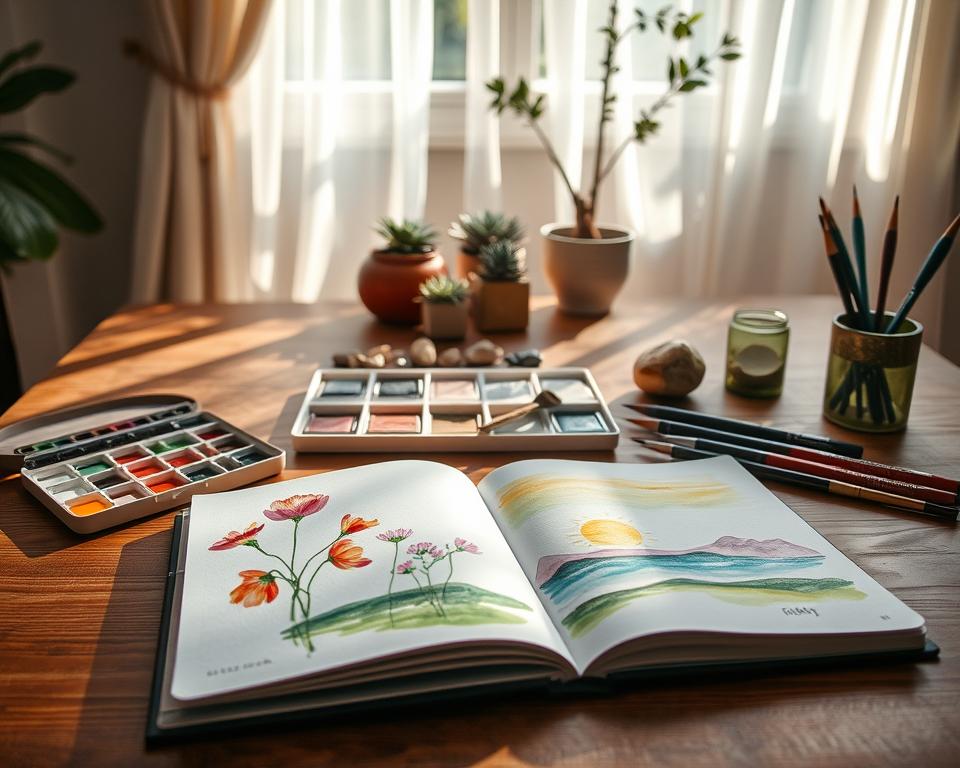
Being in nature, I notice how light changes things. It filters through leaves or reflects off water, creating amazing effects. I capture these in my journal.
Exploring Architecture
Architecture also inspires me. The shapes and structures humans create are captivating. I sketch buildings and bridges, focusing on details and surroundings.
“The world is a book, and those who do not travel read only one page.” – Saint Augustine
This quote makes me think about exploring the world. Travel or local experiences offer endless inspiration. There’s always something new to spark our creativity.
Everyday Moments
Even everyday moments can inspire us. People, food, and activities offer chances to observe and reflect. I capture these in my journal, practicing mindfulness and finding beauty in the ordinary.
| Inspiration Source | Capturing Techniques | Journaling Tips |
|---|---|---|
| Nature | Observe colors, textures, and patterns | Use watercolor to capture the essence of the natural world |
| Architecture | Sketch buildings and structures, paying attention to details | Experiment with different perspectives and angles |
| Everyday Moments | Observe people, food, and activities | Practice mindfulness by capturing the beauty in everyday life |
Exploring different sources keeps my journaling fresh and exciting. It’s a journey of discovery, and I’m grateful to be on it.
How to Start My First Watercolor Journal Page
Starting my first watercolor journal page opens a world of color and imagination. This first step is key, setting the tone for my journey.
To start, I plan my composition. I choose a theme, layout, and aesthetic. I think about what inspires me, like nature or everyday moments, to guide my creativity.
Planning My Composition
Planning is essential for visualizing the final page. I sketch ideas in a notebook or use digital tools for layouts. This lets me play with:
- Background colors and textures
- Central themes or focal points
- Additional embellishments like washi tape or stickers
Considering these elements helps me create a cohesive, visually appealing page that shows my artistic vision.
Mixing Colors and Experimentation
Mixing colors is the heart of watercolor journaling. I love trying out different color combinations for unique hues. To do this, I:
- Start with a basic color palette that fits my theme
- Experiment with mixing primary colors to create secondary hues
- Test these colors on a separate sheet of paper to see how they interact
This experimentation not only deepens my color theory knowledge but also makes my journal page personal.
Adding Text and Other Elements
Adding text and elements makes my watercolor journal page more than just a painting. I include:
- Quotes or lyrics that inspire me
- Journal entries or reflections on my creative journey
- Photographs or ephemera that complement my artwork
By combining these, I create a rich, layered page that tells a story and captures my watercolor journaling essence.
Finishing my first watercolor journal page, I feel accomplished and excited for what’s next. With each new page, I refine my skills and explore the endless possibilities of watercolor journaling.
Maintaining a Consistent Practice
Keeping up with watercolor journaling can be tough. But, I’ve found some tips to help. Consistency is key to getting better and enjoying the journey.
Setting Realistic Goals
I start by setting achievable goals. Instead of journaling every day, I aim for a few times a week. This makes it less stressful and more fun. As Julia Cameron said, “Creativity is a journey, not a destination.”
Setting specific goals helps too. Like finishing a certain number of pages or trying new techniques. It gives me direction and keeps me motivated.
Scheduling Time for Journaling
Having a set time for journaling is important. I treat it like brushing my teeth or taking a shower. This way, I always make time for my art.
I prefer journaling in the morning. It clears my mind and sets a positive tone for the day. Having a regular schedule keeps me committed to my art.
Overcoming Creative Blocks
Even with the best plans, creative blocks can happen. When they do, I remember it’s normal. To get past them, I change my environment or try new things.
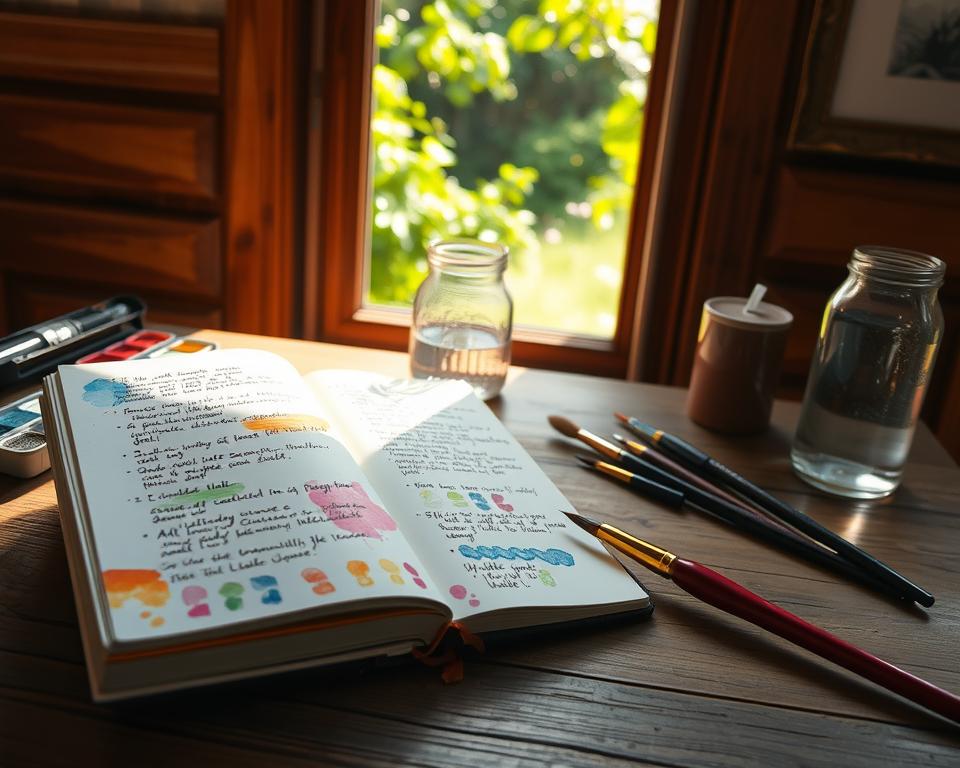
Henry Miller once said, “The moment one gives close attention to anything, it becomes interesting.” By exploring new ideas, I can overcome blocks and keep going.
Sharing My Work with Others
Sharing my watercolor journaling has opened new doors for connection and inspiration. It lets me connect with others who love watercolor sketching. This journey in mixed media art is exciting.
Photography Tips for My Artwork
To share my artwork well, I need to take great photos. Here are some tips that help:
- Use natural light to avoid harsh shadows.
- Get a good camera or smartphone with quality.
- Edit photos with Lightroom or Photoshop to improve colors and contrast.
Annie Leibovitz said, “The photograph is a bridge between the artist and the viewer.”
“You can’t wait for inspiration. You have to go after it with a club.”
This quote inspires me to capture the essence of my watercolor journaling.
Engaging on Social Media Platforms
Social media has changed how I share my watercolor journaling. Sites like Instagram and Facebook let me show my art worldwide. Here are some tips I’ve found useful:
- Post often to keep people interested.
- Use hashtags to get more views.
- Talk to my followers by replying to comments and messages.
Sharing my process and finished art has built a community. It’s inspiring to see how others react to my work and share theirs.
Feedback and Community Involvement
Feedback is very valuable when I share my work. It helps me improve, and it’s great to be in a supportive community.
| Benefits of Sharing | How to Achieve |
|---|---|
| Improved Skills | Regularly post work and ask for feedback. |
| Community Building | Engage on social media and participate in art challenges. |
As I keep sharing my watercolor journaling, I’m excited to see where it takes me. It’s inspiring to see how it affects others in mixed media art.
Exploring Different Styles and Themes
Trying out different styles and themes keeps my watercolor journaling fresh. It boosts my artistic skills and makes my mindfulness practice more rewarding.
I switch between abstract and realistic styles often. Abstract art lets me express freely, without needing to show reality. Realistic art pushes me to see and draw the world accurately.
Abstract vs. Realistic Approaches
Abstract and realistic styles each have their own appeal. Abstract art frees my creativity, while realistic art sharpens my observation skills.
| Characteristics | Abstract Approach | Realistic Approach |
|---|---|---|
| Expression | Emotional, spontaneous | Observational, detailed |
| Creativity | Freedom to experiment | Accuracy and representation |
| Skill Development | Enhances imagination | Improves observational skills |
Seasonal Themes in My Journaling
Adding seasonal themes to my journaling enriches it. Each season offers its own colors and ideas, from autumn’s brights to spring’s soft hues.
- Spring: Floral motifs, pastel colors
- Summer: Warm tones, lush landscapes
- Autumn: Earthy tones, foliage
- Winter: Cool tones, frosty scenes
Integrating Mixed Media
Mixing media in my journaling sparks creativity. Combining watercolor with ink, collage, or other materials creates unique textures and effects.
Some effective techniques include:
- Layering watercolor washes with ink drawings
- Incorporating collage elements for added texture
- Using masking fluid to preserve white spaces
Exploring different styles and themes helps me grow as an artist. It makes watercolor journaling even more enjoyable.
My Favorite Resources and Tutorials
Exploring watercolor journaling has been a journey filled with learning. I’ve found great online courses, YouTube channels, and books that inspire me. I’m excited to share my top picks with you.
Online Courses for Watercolor Journaling
Online courses have changed the game for me. They offer structured learning and flexibility. Here are some of my top picks:
- Skillshare: Offers a wide range of watercolor journaling classes, from beginner to advanced levels.
- Creativebug: Provides in-depth courses on watercolor techniques and journaling.
- Artists Network University: Features courses on various aspects of watercolor art, including journaling.
Recommended YouTube Channels
YouTube is a treasure trove for visual learners like me. Here are some channels I love:
- The Art Sherpa: Offers gentle, encouraging tutorials on watercolor and mixed media.
- Doodlewash: Features a variety of watercolor and ink techniques.
- Watercolor by Wendy: Provides beautiful, relaxing tutorials on watercolor journaling.
Books That Inspire Me
Books are a big source of inspiration and learning for me. Here are some that have made a big impact:
“The Art of Watercolor Journaling” by Lisa Congdon – A complete guide to starting with watercolor journaling.
- “Watercolor for the Absolute Beginner” by Chris Stadler and Julie Fisher – Perfect for those new to watercolor.
- “The Artist’s Rule” by Nathan Fowkes – Offers inspiring prompts and techniques.
| Resource | Type | Description |
|---|---|---|
| Skillshare | Online Course | Variety of watercolor journaling classes |
| The Art Sherpa | YouTube Channel | Gentle, encouraging watercolor tutorials |
| “The Art of Watercolor Journaling” | Book | Comprehensive guide to watercolor journaling |
These resources have not only improved my skills but have also inspired me to keep exploring watercolor journaling.
Organizing My Watercolor Supplies
Organizing my watercolor supplies has changed my creativity game. A clean workspace lets me focus on watercolor painting more. I’ll share how I organize, set up a workspace, and the benefits of digital and traditional methods.
Storage Solutions for Easy Access
Right storage is key for quick access to supplies. I use containers and organizers for paints, brushes, and paper. For example, I have a box for paints, sorted by color and type. My motto is “A place for everything, and everything in its place” for my art supplies.
For more tips on organizing, check out Sarah’s blog post. It’s been super helpful for me.
Creating a Dedicated Workspace
A dedicated space boosts productivity and creativity. I’ve set up a special area for mixed media art in my home. It has all I need, from paints to paper, and inspires me.
A fellow artist once said,
“The space in which we create is as important as the art we create within it.”
This quote really hits home. A well-organized, inspiring workspace has greatly improved my art.
Digital vs. Traditional Organization
In today’s world, we have many digital tools for organizing. I’ve tried both digital and traditional methods. Digital tools are good for planning, but traditional methods like storage and notebooks work better for daily organization.
Combining digital and traditional methods has been best for my watercolor journaling. This way, I keep my workspace tidy and efficient.
Reflecting on My Artistic Growth
As I keep going on my watercolor journaling path, looking back at my growth is key. It helps me see where I need to get better and learn new ways to create. This is vital for my creative journey.
Tracking Progress
Writing down my progress helps me see how far I’ve gone. It shows me what I’ve accomplished. This helps me get better and keeps me excited to keep exploring watercolor journaling.
Achieving Milestones
Reaching milestones, like finishing a tough piece or learning a new skill, is a big deal. It shows me how hard I’ve worked and pushes me to keep growing. It’s a way to celebrate my efforts and keep pushing myself.
Setting Future Goals
Looking ahead, I set goals for my watercolor journey. Maybe it’s trying out new techniques or making a certain number of journal pages. Setting goals keeps me focused and driven to keep improving.
By always looking back and improving, I grow closer to watercolor journaling. It makes my creative journey more meaningful and fulfilling.